
I have a lot of Practice

I am about to sit down to practice the guitar.  I take lessons once a week and I practice daily.  I run scales, play songs from sheet music and I improvise solos over backing tracks that my teacher provided on CD or that I find online.  Later today I plan to go to my local yoga studio to engage in my regular practice of asana.  This morning I engaged in my daily practice of meditation.  Oh, I also have a consulting practice.

So as I boil this down a bit, and without consulting Webster, it seems I have several meanings of practice.  Preparing as Learning, Doing through Repetition, Beingness in the World.

I think we move between these states constantly.

There are domains in which we are in the first stages of practice.  These are new projects, skills we are acquiring, relationship we are embarking on and acts of creation in their infancy.  In these stages our Practice is a learning process, a defining of the parameters and acquiring the experiences that we need to move forward.  I don’t love scales, but they are necessary for me to gain competence and confidence and fluidity with the musical notation, the physical movement of my hands and the terrain and geography of the guitars fretboard.  New projects or clients require research, planning and preparation.  New relationships require exploration, inquiry, accustoming and accommodating our styles and preferences to the styles and preference of the other person.

In the second stage of practice we repeating and refining.  We use our feedback to tune the action to meet the goals we have set.  When I play certain songs over and over, my muscles are incorporating a memory of where they need to be and my mind is freeing itself so I can really hear what is going on, sense the chord changes and allow myself to improvise over those changes.  The same is true when I am in the classroom or with a client.  When my material is a part of me, I respond quickly and easily to the needs of people present in the moment, bringing the right examples or analogy or changing the practice slightly to suit the needs of a client implementing a new system.  In my yoga practice, through repetition I find the expression of balance, strength, focus and alignment coming together.  Because we are following a repeated series, I can gauge where my alignment is and correct it.  I have a reference point, especially when I have received ‘adjustments’ from teachers to help me feel the proper alignment and expression of the pose.  Through repetition, I become my own inner reference point.

In the third stage of our creation our practice is who we are.  I do not mean to infer that we are ‘done’ or perfect or that we don’t have more learning and repetition to do.  However, as we internalize those learnings and practices we morph from Human Doings to Human Beings.  We become practitioners of our own excellence.  We do this in a state of constant testing, honing, changing, experimenting, failing, falling, growing and improvement.  We are not static.  We are dynamic, vibrant, engaged, vulnerable, honest, enthusiastic, flexible and creative.
Tagged with: , , , , , , , , , , ,
Posted in personal productivity

Mind Maps for Meeting Notes

Mind Maps are a non-linear method of capturing thoughts.  They work like our minds work, in a web of interconnected thoughts, ideas, concepts.  Here’s a Wiki on them if the process is new to you.  They are great way to brainstorm, free associate and kick start the creative process.  I use them often to outline when I am gestating a piece I am writing or at the start of a project plan.  For writing, I find it easier to address the white space of an empty page in the free associative manner of mind maps and they are a great way to see the interconnection between topics, subjects, sources etc.  For projects, they are much more free form than a GANTT chart approach and appropriate for the early phase of planning though not necessarily the project management phase once you have clearly defined the plan.

At first I did them on paper, then I found a software took called MindJet/MindManager.  I used it on Windows and now use it on iPad and Mac.  At this point it is a cloud based platform with a full set of features.  There are other tools as well, some open source, so play around and find what works for you.  Using the software opened up a few great efficiency features that paper can’t afford you.  MindJet allows me to export my maps in several key formats.  If I am outlining, I can export to Word and quickly take my outline to completed report, memo, agenda, training session or whatever I am producing.  If I am creating a presentation, I can export directly to PowerPoint and save a great deal of work.  Each subtopic becomes a slide with bullet points (based on the level of outlining you have done)  If I am in project planning mode, I can export to MS Project (this is available in the Windows version of MindJet only at this time) and take the plan into greater detail, assigning resources, interdependencies and all the attributes needed to actually manage with robust project management technology.  If you have ever tried to brainstorm in MS Project, you know it is fruitless.  Start in a mind mapping tool like MindJet first and you will get much more done.  It works great in a project kickoff meeting with someone as scribe on a laptop and everyone joining in with map projected on a screen.

What I realized is that mind mapping is also a great way to take meeting notes.  Meetings never proceed from one agenda item down the list with all discussion (and therefore the attendant notes) falling neatly in one discreet section of my notes.  Meetings ramble back and forth, projects, activities, people and information in those settings are frequently connected, overlapping and causal in relationship to each other.  As a result meeting notes can be a mess.  I also really wonder about the people I see every day with moleskins or notebooks, taking notes in volumes.  How do they go back and find what they need in those notes and most importantly, how do they track the actions they commit to?

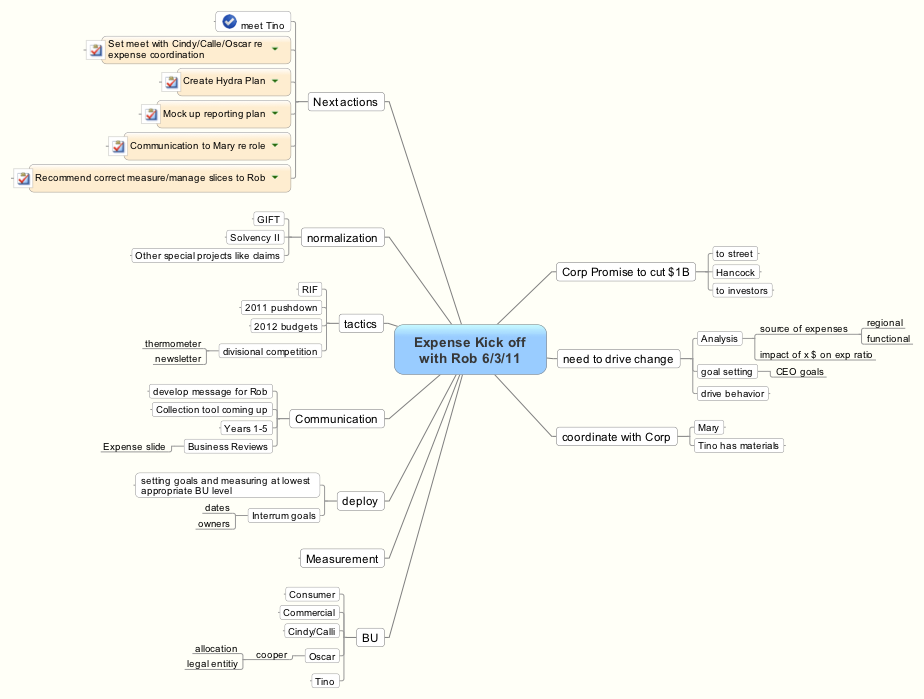
By using mind maps, I am able to move back and forth between topics in my map as the discussion ranges back and forth and keep adding more detail to the topic section of my map.  In linear note taking, I either have no more space ‘back’ at the earlier topic location or can’t find the separate parts of a disjointed conversation.  In addition, using maps lets me highlight the interconnections between topics.  The map also makes it very easy to type up my notes if I have to distribute meeting minutes or for my own use.  Once I started mapping directly on a laptop or now my iPad I gained the additional benefit of legibility (my chicken scratch is indecipherable even to me). Here is a sample from a meeting I chaired:

Expense Kick off with Rob 6.3.11

When I made the switch to digital for all my mapping I discovered another trick that was a real light bulb moment.  I like to keep one map topic called Next Actions so that regardless of the agenda item under discussion, all my next actions or to-dos from the meeting are in one spot so I can transfer them to my task list. If your task list is in MS Outlook, the integration of MindJet with Outlook will be a real time saver for you.  Notice in the upper left corner of my map is the sub-topic called Next Actions.  MindJet has a variety of icons you can assign to individual bubbles on the map.  I just select all my Next Actions, then I use a Task Marker to tag them. When I export the map to MS Outlook, there is a setting in the Export Dialog box which I check that allows me to export only task items in my map (instead of all topics and sub-topics) and voila, all my next actions from the meeting are automatically turned into tasks in my Outlook system.

What is amazing, at least for me, is that this non-linear approach is actually the straightest line from first flash of a new idea to fleshing it out and turning it into actionable steps and capturing those steps in my productivity system.  As I mentioned, there are many tools, they all offer different features and levels of integration across the tool sets we use for planning, tracking, persuading, presenting etc.  MindJet works for me in my system and the way I go about work, find what works for you.

Tagged with: , , , , , , , , , , ,
Posted in personal productivity

We’re surfing not sculpting

20130403-101518.jpgI read something today that essentially said ‘we can’t control anything, what looks like mastery is really just cooperating with what is’.

It looks like control because it is happening in real time. We are alert, aware, supple and responsive. We have a goal and a plan, but we adjust in the moment to the reality that is present, not just plug along like bulls.

We aren’t blindly obedient to a set of plans laid out at the beginning of the project, we update. We aren’t carving our life in stone. We are riding the wave.

Tagged with: , , , , ,
Posted in Leadership, personal productivity

We Fail to Learn

One of the fastest ways to learn is to fail. Information, instruction and feedback in the context of an experience of failure is more useful than abstractly presented curriculum in no particular context other that the learning environment itself (classroom).  The proponent, theorist and practitioner from whom I learned the most about this is Roger Schank.  When I worked in Corporate Training, we brought in his Learning Sciences team and implemented a few of their immersive, self paced learning programs.  One of my favorites was called 1-800-SERVICE.  A customer service e-learning environment, the training starts with a phone ringing.  You, as the learning, have the role of service representative.  You have to answer the phone and there is a voice on the other end in need of customer service.  There aren’t long lists of the ten keys to service or training in advance of this phone call.  There is a ringing phone and person who needs assistance.  You dive in, select responses to give the caller from short libraries of options.  Expert advise, coaching and informative resources are available only after to engage in action.  If you don’t pick up that phone, nothing happens.  There is no learning without action.

We have to get to edge to learn.  That is how we expand.  In yoga, I particularly struggle with some of the balance poses, headstand, crow even tree.  I find it useful to go all the way to the edge, which in this case often means landing on my head, in order to reach the place of balance, and strength.  As an aside, I have also learned that two keys to these balance poses are Drishti (where am I focused) and Active Core (balance comes from my center not my limbs). My point is that unless I put myself on the edge of failure, I do not learn in the context of this evolving practice.

If we are standing still, we get no feedback.  We refuse to move out of a fear of failure, when in fact failure will bring the feedback we need to move in the direction of success.  Taking a wrong step is much more valuable in terms of getting to our goal because from the misstep issues guidance and from guidance issues learning.

This is the hidden message in the Yoda and W.H. Murray quotes from last week.

“Do or do not”

“Whatever you can do or dream you can, begin it”

Tagged with: , , , , , , ,
Posted in personal productivity

Suffer the Fool

In literature, the Fool is the character who can tell the truth at all times. He has that freedom because his medium is humor. Add to that an acute level of self-deprecation.  He doesn’t take himself too seriously, nor hold himself up high and as a result people, kings in fact, listen to him and seek his counsel.

We need people to tell us the truth.  But we won’t always pay attention to the feedback coming our way.  Our veneer of protection is frequently a portrayal of ourselves as ‘in command’, ‘totally together’ and we can’t show what we believe would be weakness if we admitted that we do in fact need feedback, support, advise, coaching, etc.

Earlier in my career when I was a sales person, I attended a set of training sessions.  One of the key techniques was the “Columbo” persona.  The premise was that when we are too slick and polished or have a know it all attitude, the people with whom we most need to communicate are so guarded and self protective that our message never gets through and true dialog about needs and solutions can’t take place.  When we seem to need a little help, the natural tendency that humans have to aid those in need kicks in.  On the old TV detective show, Lt. Columbo was slightly disheveled and seemingly disorganized.  Forgetful and eternally apologetic, he lulled the killers into letting down their guard and revealing the clues and evidence needed to convict them.

The teams we lead will grow in cohesion and effectiveness when we let down our facade of false perfection and allow those around us to be ‘truth tellers’.  When we show that we are open to the feedback from all 360 degrees of our environment, including supervisors, peers, employees, customers and others, we demonstrate that the fool is the one avoiding the truth, not the one presenting the truth.

Tagged with: , ,
Posted in Leadership, personal productivity

There is no Try part 2

An employee of mine once gave me a paperweight with the following question etched on it:

“What would you attempt if you knew you could not fail?”

That has been an inspiration to me.

Posted in personal productivity

Chakras and Productivity

In Yoga and other practices there is a knowledge of energy systems called Chakras.  I think of them as a system of reservoirs and locks that work much as a system of canals like the Panama or Suez canals.  There is not a value judgement that one Chakra is better or higher or more advanced.  To function optimally, we want to access and flow with any and all as they are needed. They have many varied symbologies, using images, colors, sounds etc.  What I present here is my interpretation of the seven Chakras with a focus on how the qualities of each interact to form a dynamic in our practice of productivity.

Chakra Quality Challenge Productivity Paradigm Question to Ask
First Grounding Manifestation Stagnation or flightiness When we have a solid base systemic practice we can achieve our goals Am I on solid ground?
Second Flowing/Moving Fear With a solid base our energy can flow to the ideas, projects and people that bring joy and success Do I feel free to move on this?
Third Power/Action Willfulness We get what we go after by engaging all our focus and moving carefully in service of our goals and the goals of others What will be the impact when I am successful with my goal?
Fourth Relationship Isolation or dependence When we dovetail our outcomes with those of others we multiply the effect. Who can I engage with to achieve my goals?
Fifth Communication Listening Clear communication leads to alignment of vision and action in teamwork and within ourselves. What is my message?
Sixth Vision Illusion Outcomes fully and clearly visualized are much more likely to be realized. What outcome am I envisioning?
Seventh Purpose Clarity Visions and Goals that flow from and are grounded in our personal sense of purpose will garner the energy and enthusiasm to carry through How does my vision/plan align with my purpose?

When our system is functioning optimally, our projects and actions are moving through the stages from Purpose and Vision to communication, team building, action and successful manifestation fluidly.  When one of our goals, projects, objectives is stuck, we can figure out where and ask ourselves what we need to do to get it moving again.

Tagged with: , , , ,
Posted in personal productivity

Quote of the Day

“Until one is committed, there is hesitancy, the chance to draw back, always ineffectiveness. Concerning all acts of initiative (and creation), there is one elementary truth, the ignorance of which kills countless ideas and splendid plans: that the moment one definitely commits oneself, then Providence moves too. All sorts of things occur to help one that would never otherwise have occurred. A whole stream of events issues from the decision, raising in one’s favour all manner of unforeseen incidents and meetings and material assistance, which no man could have dreamt would have come his way. I learned a deep respect for one of Goethe’s couplets:

Whatever you can do or dream you can, begin it.
Boldness has genius, power and magic in it!”


-W.H. Murray – Scottish Mountaineer


Tagged with: , , , ,
Posted in personal productivity, Quotes

Passin Thru

Yesterday afternoon I was listening to the radio station of Columbia University here in NYC. They were playing three hours of music by a favorite sax player of mine named Oliver Lake. One of the tunes was called Passin’ Thru. I seriously doubt the DJ knew that the following day would be the start of the Jewish holiday Passover. I didn’t even make the connection until today when I was thinking about a topic for this post.

Passover is an interesting holiday in that it has history but it also has a strong degree of Practice involved. There is all the of the cleaning out of the household in order to get the bread out of the kitchen. The family conducts a Chumetz hunt.  Think of it as a ritual cleaning. Everything not Kosher of Passover (or K for P) can be bagged up and donated. The process requires you to look at everything you have and make a decision.  Is this item K for P or not.

In an effective practice of productivity we are looking at our inventory and making decisions. What is this? Does it relate to something I am working on or committed to? Will I need it as future reference? Does it belong to someone else, if so who? Does this represent an action I need to take? Does this represent a project I need to define and initiate? Does this relate to a meeting I have coming up or need to schedule? Does this represent a communication I need to have with someone?

When we make these decisions as items come into our inventory, our systems are always K for P. When we let inventory pile up (see my post about an empty inbox) then we need to periodically undertake a cleansing of our systems and environment (ie, our desk, office, garage, mental holding areas) to get there.


Tagged with: , ,
Posted in personal productivity

There is no Try

In this clip Yoda teaches the greatest lesson. Don’t try! Do! Line up your action with your intention and there is no trying (which means no struggle, no trial as in testing or inquisition). If you watch the rest of the sequence in the movie you see the great effort that Luke exerts in failure and the deep focus and effortlessness of Yoda in success.

The other hidden gem, which I heard for the first time re-watching today, is Yoda’s comment that there is so much to unlearn. I think we have conditioned ourself with limiting beliefs about what we can accomplish. We reach the point where we won’t even try anymore.  We have so much to unlearn.


Tagged with: , , , ,
Posted in personal productivity, Quotes