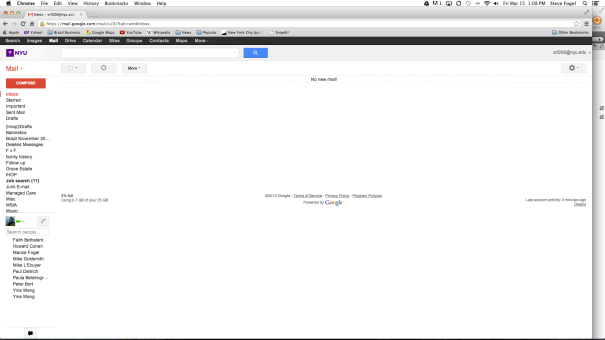
I have an empty Inbox

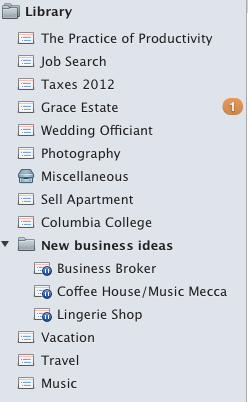
Empty INboxYou may have never seen one of these.  It’s an empty inbox.  Most people I know have thousands of emails sitting in their inboxes.  What a Weight!  The stress of it is astounding. Conversely there is both a freedom and a positive type of inertia effect from having all of your emails out and where they belong; turned into ‘to-do’ actions (in my case using a neat add-in from OmniFocus that lets me turn emails into items in my project/task management tool), calendar events (my reference numbers for concerts, or contact and address information for appointments are where I need them when I need them.  If you use Google Mail/Calendar you want to learn the Create an Event option built into GMail), in reference folders or IN THE TRASH.  Think of the time you waste reviewing the same pile of emails over and over, not to mention the hassle of finding the item you actually need at the moment you need it.

The positive inertial force is that just as an object in motion tends to stay in motion, a person in order tends to stay in order.  The cycle of completion is something I will delve into in more detail in another post, but think of it like this.  We, as human beings, comprise a closed energy system.  We only have so much attention we can allocate to the myriad promises we make, tasks we undertake, projects we have, etc.  We can, over time, increase the amount of energy in the system through exercise, proper diet, mental practices of focus, meditation or cognitive training.  Go ahead and do all the things you can to build up your available energy, but for the most part that will be only incremental.  Every time we commit to some action (we make a promise to ourselves or others), or we are assigned some action (the boss, spouse, kids delegate to us), or pend some action (we leave email in the inbox waiting to decide about it later), we tie up some piece of our closed energy system in preparation to do that work.  Let’s call the part of your consciousness that is the gatekeeper to your energy, commitments, body and survival; The Basic Self.  (here is a link to one view on the dynamic involved).  Every time we do the thing we commit to, the energy is released and available for new work, new commitments, etc.  Think back to the rush of energy you feel when you clear out old ‘to-dos’.  The real juice is releasing the energy we have tied up within ourselves remembering commitments we could more readily track with an external system or process.  Our full inbox is an albatross robbing us of energy.  We need that energy available to do stuff, not remember stuff.  Every item we clear from our inbox, by making a decision about it and moving it through our personal productivity system, releases our energy.  By the way, the more we keep our commitments, the more our Basic Self trusts us and provides the energy we need (it can stop hoarding and we stop feeling lethargic, overwhelmed and anxious).

Finally, just as that inertial object wants to stay in motion, our clean inbox wants to stay clean so we feel motivated to keep the virtuous cycle going and in the process free ourselves to be productive, engaged and satisfied.

Tagged with: , , , , , ,
Posted in personal productivity, Wellness

The Jazz Leadership Model

Everything I know about leadership, I learned from Miles Davis.  Well that’s a bit of hyperbole, but truer than it might look at first glance.
What are some of the qualities of Great Leaders.  They:

  1. Build and inspire great teams
  2. Set a vision
  3. Create a lasting body of work
  4. Take risks
  5. Innovate
  6. Inspire

Certainly we could list many more.

So how does this apply to Miles Davis.

Innovation.  Miles was the creator of or one of the main artists in at least three of jazz’ most important genres or schools.  As Charlie Parker’s collaborator he was arguably the last great trumpeter of the be-bop era.  Then Miles as a composer and band leader created the Cool Jazz Movement.  Ten years later, he introduced electric instruments with cacophonous effect to create the earliest jazz-fusion.  Clearly he had a vision well beyond that which was right in front of him.  Never content to rest on laurels, he reinvented himself and the music over and over again.  He took risks and as a trail blazer, alienated fans who wanted to hear the old music.  His body of compositions are a list of standards, from So What to MileStones to Solar or Bitches Brew.  His version of standards like Summertime, My Funny Valentine are the ones most jazz fans think of as definitive.

What may get overlooked is the way Miles built teams, communicated with and inspired generations of other musicians.  The list of players who went from unheard of sidemen to become jazz luminaries in their own right is immense.  John Coltrane, Cannonball Adderly, Gerry Mulligan, Bill Evans, Herbie Hancock, Chick Corea, Dave Holland, Tony Williams, Jack DeJohnette, John McLaughlin, Joe Zawinul to name just a few.  Now think of all the music and musicians that grew out of the talent and leadership of these players.  The leadership DNA from Miles has been seeding innovation and achievement for more than sixty years.

Another key to the Jazz Leadership model is an environment of support that encourages risk taking and experimentation.  An ensemble is given every note to play.  They are given parameters (a melody line, some chord changes, a starting tempo) and then together they create within the context laid forth.  When the leader gives too little direction, the result is noise and pointless noodling.  Too much direction and the spontaneity and invention are missing.  When the team is listening to each other, adding their contribution with confidence and still providing space for the contribution of others the result can be bold, exciting, touching, inspiring, unique, surprising and uplifting.

How can we bring key leadership qualities of talent development, inspiring vision and an creating an environment that fosters creativity and innovation into our own businesses, workplaces, projects, families and homes?


Tagged with: , , ,
Posted in Leadership

Practice Quote of the Day

In theory there is no difference between theory and practice. In practice there is.

Yogi Berra

Tagged with: , , ,
Posted in personal productivity, Quotes

Prepare

“By failing to prepare, you are preparing to fail.”

― Benjamin Franklin

We have had the value and necessity of planning drummed into our heads.  Clearly, having a plan, taking time to prepare, getting our goals defined are prerequisites to consistent success. Covey talks about sharpening the saw in his Seven Habits   I am a huge advocate of the vision work we each do in order to get a plan in place that has clearly defined outcomes and a set of actions that get us to the goal.

Screen Shot 2013-03-19 at 12.28.22 PMNow that I have a yoga practice, I see a new side of Prepare.  I hear the word in every class.  During the Sun Salutations as we move from a deep bend called Uttanasana into a somewhat strenuous series called a Vinyasa, we pause.  We Prepare.  We breathe in and get our alignment as we move from the pose of compression to the series of exertions.  We are active in our bodies, extending our spine and raising our gaze.  It is a mindful moment that combines focus and rest.  I’d like to bring more of that into my preparation.  Focus, Ease, Extension and Alignment.  I think the practice applies, even in the realm of projects and productivity.

Tagged with: , , , ,
Posted in personal productivity

Multi-dimensional task focus

I advocate a multi-dimensional view of the tasks or actions that I track.  I have a project focus, a context focus, a people focus with time and people attributes where appropriate.  The genesis of this process and practice comes from David Allen’s Getting Things Done (actually from its antecedent call Insight IV A:The Professional Seminar) and I recommend that you start with his excellent seminars, books and web resources at The David Allen Company.  The method is independent of the tools you use to implement.  I started twenty-three years ago using the Time Design System, I’ve tried every device, from the earliest version of the Palm Pilot, through the Treo and the Blackberry with some degree or another (depending on platform) of integration with Outlook Task/Calendar. Today I use OmniFocus for Mac, iPhone and iPad.  As an aside I tried the Apple Newton way back in the day, but unfortunately it was too limited in capability to employ as a productivity system.

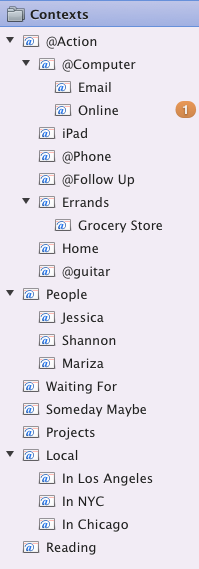
OmniFocus Context ListOne limit of task lists in Outlook or iCal/iTask is that they are one dimensional.  I can assign a category but nothing more.  The value of OmniFocus or the Getting Things Done add-in is that they enable the three-dimensional view. How does this work?  I created a set of contexts in which I do work, @home, @computer, @phone, @iPad,@followup as well as contexts like waiting for, errands.  I have sub contexts under @computer such as online, email.  I even have a context called @guitar.  This way, I only look at the actions that can be completed in that context or with access to that tool.  I can’t make calls on the commuter train (I could but it would be rude) or learn My Favorite Things on guitar, but I could send an email or catch up on reference material I have downloaded. I have contexts for locations I visit with tasks that can only be accomplished in those cities.  I have contexts for particular people with tasks I can only accomplish with them or need to communicate with them.

OmniFocus Project List

I also have a project focus. A project would be a specific goal or outcome that requires a group of tasks that can be executed in parallel or series.  The project may have a deadline or not, but it has a definable end or successful completion in mind.  For me it makes all the difference in the world that I can tag my tasks by context and project.  I can go into “planning mode” where I get my juices flowing, get creative, brainstorm, mind map, define my end game, get a vision of the completed project etc.  Project focus also lets me get a snapshot at any point in time; what has been completed, what is left to do, am I missing any tasks that need to be added, do I need input from anyone?

By combining more than one dimension of focus, I insure I have a view of my universe of commitments, goals and options that fits the moment.  If I want to go big picture and plan or do an organized review of my projects and open items, I can use a project focus.  If I am sitting at my computer and ready to do concentrated work for a period of time I can zoom right in on the current context.  If I am in Chicago, visiting my daughter and want a quick list of things I wanted to see or do the next time I was in the city, I have it at my finger tips. And by being integrated across platforms, I always have my information with me so I can access or add to it on the run.

Future posts will contain tips I have found in moving onto and using OmniFocus as well as tailoring it to your needs.

Tagged with: , , , , , , , , , ,
Posted in personal productivity

The Lesson of Aikido

I came across this quote in one of my journals today “when you don’t resist, there is no pressure”.

One of my previous posts was on Letting Go.  Today’s is on Letting Through.

Resistance requires so much energy.  No wonder we feel so worn out.  We resist with our mind those things we don’t want to know about or hear about because they challenge our views or opinions or self-concepts.  We resist with our emotions those things we fear are evil or wrong or bad.  From Aikido we learn that if we hold our balance and let the external forces roll by us, we neutralize without resistance.

So how could this look applied to ourselves.  Other people’s opinions, ideas and demands are interesting, look at them to see if there is value to be gleaned and if not. PASS.  There is no need to argue or contend. Acceptance does not equal agreement.  We can accept another’s input without giving away our solid ground.  Now let’s be careful not to reject out of hand.  Let it through, be truly open to take what is of value and let the rest keep moving through. (in yoga we encounter the concept of vinyasa which equates to moving on the breath, sometimes also called moving through).  What about our own thoughts, which so often feel like an onslaught or plague.  It’s my experience that while we may quiet the mind in some small degree, we cannot shut it down, no would we want to.  The skill is to let the thoughts come up and let them move through.  We are not responsible for what thoughts we have, we are responsible for which ones we hold. An important distinction as we let go of resistance and pressure.

The emotions work in much the same way.  When we resist and hold we get into a locked position that creates pressure.  I just have to look at my relationships to see this dynamic at work.  When I feel resentment, I know there is a feeling like anger, hurt, judgement etc that I have been pressing up against.  I am resisting the relationship and feeling the pressure.  Guilt works the same way, it’s just directed at myself instead of others.  I’m not saying that we don’t work through the feelings.  I’m suggesting that there is little chance of doing productive work when we are locked in resistance.  The first step is to get flowing so we are free to deal with whatever comes our way.

Productivity works the same way.  We all feel pressure.  Certainly much is imposed externally through deadlines, expectation of our bosses or clients etc.  My suggestion is to look for the places where we can let the deadlines, expectations and demands flow through, we capture the pertinent data and process it through our organizational system, without resistance, so we can remain agile and flexible to do actual work.  How does my work resistance look?  If I am procrastinating, complaining and out of focus, there is a good chance I am in resistance.  That’s a good time to get back to the processes that have worked for me, empty my inbox, review my goals, commitments, communications and get cleared out so I can move back to a natural state of flexibility and productivity.

Tagged with: , , , ,
Posted in personal productivity

Position Comfortably Held

Another yoga analogy. It is much more valuable, for me, to do a difficult asana like the Half Moon Pose (Ardha Chandrasana) using a block rather than straining to do without. In fact, I end up with just a fingertip on the block. In essence it’s not really holding me but I can get so much more joy and openness by not having to go to pain but rather doing the position comfortably and with support.

When I was taking Cognitive Science courses for my masters, I was introduced to the pedagogical concept of scaffolding. We learn a new skill more easily with a small amount of support. Not spoon-feeding, the challenge is needed to truly engage us, but just the right amount of structure to guide us. Over time, the scaffolding is removed and the learner is doing it on their own. The classic example of course is training wheels.

So, now, how do we look at the areas where we struggle to go it alone, with a ‘no pain, no gain’ attitude and find we aren’t achieving our goals. Having a system of capturing our to-do’s, organizing our projects, processing our email, mail, news feeds and myriad modes of input is a structure of support. When we practice our system regularly we come to a point where it has become so ingrained that we are no longer making an effort. We are resting the lightest amount of our weight on it and opening up to accomplish what we’ve put in motion with ease.

Tagged with: , , ,
Posted in personal productivity

How do you get to Carnegie Hall?

Practice , practice, practice.

Repetition lets us take a skill and move it through the stages of Johari’s window. From blind spot to conscious competence. In fact it allows us to move to a cognitive place of automation to the extent that we no longer have to engage attention in order to act. We don’t have to consume any portion of our limited working memory because through repetition, the action has become innate.  We reach a state of fluency in which freedom and creativity arise.

When our practice of productivity becomes second nature as a result of constant repetition a few key things arise:

  • We trust ourselves.  In fact we have earned the trust of that part of ourselves that is the gatekeeper to the allocation of our energy and attention.
  • Others trust us to do what we say because we have consistently either delivered on our commitments or engaged in renegotiating our commitments to ensure we are delivering within the parameters to which all parties have agreed.
  • We have more energy, enthusiasm and concentration.  The paradox of the practice of productivity is that when we complete our actions, we feel primed to do more.  When we don’t, we feel the lethargy build and the motivation to act wane.  Incompletions have weight and can feel oppressive.  Completion is liberating and invigorating.
Tagged with: , , , ,
Posted in personal productivity

Don’t Postpone Joy

I first found this button in a store on the upper west side of Manhattan in the 1980’s. My father introduced me to a place called The Last Wound-Up. Imagine a 20 something and a fifty something busting a gut laughing and playing with little wind up toys.  Over the years I gave out hundreds to people and kept one pinned to the curtain of the bathroom in my home so I would see it everyday.  For thirty years this has been my motto.20130312-115945.jpg

Joy, love, fun, adventure, creation, play etc. are not things we left behind in childhood or must wait until the time is right to experience. Bringing the energy of enthusiasm present right here and now increases our capacity to work, focus, plan and accomplish our goals. It’s how we get there, not the reward.  I read and here a lot of talk about work life balance as though we don’t have life in our work. If we don’t then let’s put it in there. That way our life is always in balance and work is not what we endure so we can live, it is an expression of our purpose and our joy.


Tagged with: , , ,
Posted in personal productivity

Change

“Few will have the greatness to bend history itself; but each of us can work to change a small portion of events, and in the total of all those acts will be written the history of this generation.”

Robert F. Kennedy

Tagged with: ,
Posted in personal productivity