Getting Stuff From eMail To OmniFocus For iPad

I am presenting a link here to a valuable article with a tip on quickly making an email inbox item available in your OmniFocus inbox.

iOS Productivity: Getting Stuff From Mail To OmniFocus For iPad.

I have been using the email to OmniFocus option (just forward from your iPad to send-to-omnifocus@omnigroup.com) with pretty good success.  You end up with an unwieldly next action item, but I prefer this method to installing another app.

This is an iOS solution only.  If you are in email on your desktop, remember you can just right click and item and select ‘send to OmniFocus’ from context sensitive menu.

Tagged with: , , , , , , , , ,
Posted in personal productivity

Workers of the World, Untie! (not a typo)

It’s May Day. Union membership is at a historic low in this country. A major reason is the anti union tactics of businesses. Another is the protections stripped from unions by local and federal legislation. Media vilification has contributed as has the general shift to the right of the populace.

But after we blame the villains, we are left with additional facts. The shift of the American economy away from the manufacturing and moving of goods into the service and knowledge industries has atomized the workforce. Freelancers are the piece workers of the twenty first century. The self employed are engaged eighty percent of the time in selling and marketing and networking and identify themselves as businesses or corporations.

We are more connected than ever technologically. We are more disconnected than ever as a workforce. Even in a pre-industruial age, when most of the population was engaged in agriculture, there was at least physical proximity if nothing else. We worked together in the fields. Hell we sang songs. Maybe we were slaves or serfs living a meager subsistence existence, some of the social bonds of family, church etc were strong. Artisans had guilds again with the hitch that many were indentured during their long periods of apprenticeship.

I am at work right now.  Ironically, sitting alone at my computer.  Actually I started writing this post alone in my kitchen on my iPad.  I am networked and untied (rarely wear ties any more) in my own home.

What will be the next form of collectivity amongst the newly decentralized working class, where many of us are identified as sole proprietors or freelancers or 1099ers?  Can we unite and be untied?

Tagged with: , , , ,
Posted in Leadership, personal productivity

Avuncular

We’re born to our parents. We love them or not. The former is a great blessing, the latter a burden. We make friends, some for a lifetime, some for a season or two. They sustain us and connect us with bonds that are freer than filial because we chose them. We find mentors, those whose wisdom and example carry us forward in our personal and professional lives. We seek teachers, secular and spiritual who shed a light that we can follow in our intellectual and metaphysical growth.

We are blessed with certain people who fall into a category in between. As relatives, they posses that certain magic that blood carries, uniting us with the lineage and history that belongs to us. As those of the generation of our parents they represent not only our past but also on some level our future (am I going to look like that some day?). But as non-parents or siblings, they come without much baggage. Their jokes are funny without being repeated a thousand times. Their advise is sage without being overbearing. We love them unconditionally. The are rare and precious precisely because they are irreplaceable.

for Albert

Tagged with: , , , , ,
Posted in Leadership, Wellness

Occam’s Razor and Applesauce

As I was cutting apples for applesauce this morning I was thinking about simplicity.  Here’s my recipe:

Apples
Cinnamon

Cut apples,  sprinkle with cinnamon, cook in pressure cooker on low heat until done.

Simple.

Occam’s Razor is the name of the principle that the simplest explanation or solution is likely to be the correct one.

How do we create the experiences, relationships or things we want in our life?  No need to resort to superstitious or magical thinking.  What, in specific detail is the goal? What’s the simplest most direct path?  What actions get us there?  What is the next step?  Who has information or experience to share on the actions and path required.  When can I take the next step?  What is the step after that?  Are the steps all sequential or can some be executed in parallel?

Simple.  Maybe not easy, but simple.

Recipe for success:

Clearly define the desired outcome.
Identify the steps (if there are more than one)
Take the first step
Course correct in the presence of feedback
Repeat until complete
Celebrate


Tagged with: , , , , , , ,
Posted in personal productivity

We are not our limited self image. We are our picture of success!

I mentioned previously that I have a paperweight on my desk that says ‘what would you do if you knew you couldn’t fail?’

I have also drawn the conclusion that without failure we make no progress nor gain learning and experience.

And still, I have to encourage myself past my fear of failure to stake out new dreams and pursue them.  Why?  Or the more useful answer would be; How do I make this work for me?  Is there a risk/reward calculation that’s taking place unconsciously?  If I fail is there a cost and is that cost monetary? Is it a blow to my ego? Will I look stupid?  Will the cost be the loss of other opportunities due to doors closed by my failure?  How do I focus on the reward side instead of the risk side?

Our imaginations literally program our consciousness.  The pictures we hold influence our attitude, our actions and therefore our outcomes.  I know this and yet I still have to remind myself to create robust, completely realized images of the positive outcomes I want to manifest.  See it in detail, hear it, feel it.  All in the present, happening now.  When I fill myself with the joy of success, I have success.  Even as it is coming to pass.  I am not waiting.

Tagged with: , , , , , , ,
Posted in personal productivity, Wellness

“Practice and a…

“Practice and all is coming.”
Pattabhi Jois

Tagged with: , ,
Posted in personal productivity, Quotes

Moving from Outlook to OmniFocus

As I mentioned in another post, I had all my productivity systems for calendar, tasks, contacts, projects built around my company’s in-house Microsoft Outlook platform (with the addition of the Getting Things Done add-on from the David Allen Company).  In the process of moving my entire system (feels like my entire life) onto another platform, I tried several project/task managers and settled on OmniFocus.  One main reason is that OmniFocus has a suite of tools that seamless integrate across the Apple world.  I use it on my desktop, iPad and iPhone.  It links to my Google Calendar and has nifty integration with SIRI for voice activated capture of tasks when I’m on the go.

While all of that sounds great, the hard part was getting myself ported from the old platform the new one with a minimum of redundant data entry.  Here were the steps I took

  1. I output my Outlook data through the native export command that you can find in the Outlook File Menu.  Mail archives went to something called a Personal Storage or .pst file.  You can get more information from the Microsoft Support website.  I output my calendar, contacts and tasks into three simple flat files known as Comma Delimited or .csv files.  This is important, because while the mail files I created can only be opened back up in MS Outlook, the flat files I created for my productivity systems are generic and could be opened up in many if not most programs on the market.  Calendar was easily imported into Google.  Contacts went the same place with a little bit of doctoring the headings to ensure my contact names, numbers etc appeared where I wanted them.  Since I have my iPhone and iPad linked up to GMail, my calendar and contacts appeared immediately on both devices.
    Tasks are a little tougher for me, because I need more from my system than what is offered in the native tasks app in the Mac world.  
  2. Make sure that when you output your data from Outlook, you click the box that creates a header row for your data.  This inserts column headings or what could be called field names.  You’ll need that so the task names line up in the same column, the Completed y/n indicator, the Start Date, Due Date, Categories, Task Notes and so on all line up.  My task list was about 50 items long and I wanted my task attributes to flow to the new system without have to retype,  The task archive I created in Outlook need some massaging before I could import into OmniFocus and I needed a specific format.  For that purpose I downloaded a trial copy of OmniOutliner.  It was a relatively easy to open the .csv file right in OmniOutline.  From there I could get my data line up (a minimal amount of drag and drop), delete artificial fields created by Outlook and not needed in the future by eliminating entire columns in one pass and then I exported a native OmniOutliner file which was then imported directly to OmniFocus
  3. The piece I had to recreate from scratch was the Project Focus. Let me say a bit about this because it is core to my personal productivity systems.  I advocate a multi-dimensional view of the tasks or actions that I track.  I have a project focus, a context focus and a people focus.  One limit of task lists in Outlook or iCal/iTask is that they are one-dimensional.  I can assign a category but nothing more.  The value of OmniFocus or the Getting Things Done add-in is that they enable the three-dimensional view.  How does this work?  I created a set of context in which I do work, @home, @computer, @phone, @iPad,@followup as well as contexts like waiting for, errands.  I have sub contexts under @computer such as online, email.  I even have a context called @guitar.  This way, I only look at the actions that can be completed in that context or with access to that tool.  I can’t make calls on the commuter train (I could but it would be rude) or learn My Favorite Things on guitar, but I could send and email or catch up on reference material I have downloaded.
  4. Once the system was rebuilt and up and running, I found that there is excellent integration between OmniFocus and GMail, Apple devices (including using Siri to capture new tasks) and browsers that allow me to grab ideas, actions, etc and quickly move them to the OmniFocus inbox for processing.


Tagged with: , , , , , , , , , , , ,
Posted in personal productivity

Drishti, Shtira, Focus, Stabilty

When I first started thinking about the connection between the practice of yoga and the practice of productivity I was, appropriately, in a yoga class. Ultimately there are many points of synergy. Two really came out as primary. Drishti, the act of focus and Shtira the state of balance and stability. As I have continued to learn and practice yoga, I have had first hand experience of the value of focus, specifically its placement and ensuing impact on my stability.  Couple of interesting observations about Drishti.  You pick a point to focus on but your focus isn’t sharp and intense, it is soft and diffuse.  Drishti is not fixed throughout the practice, it moves from pose to pose.  Last night in class, I noticed that in a pose where my eyes tend to close, like Pidgeon, there is still a point of focus.  It’s just inner focus.

Without Focus it is almost impossible to have stability or balance called Shtira in yoga.  Stability comes, largely, from a conscious engagement of the core muscle groups, balanced foundation, breathing and of course Focus or Drishti. To me, stability is not rigid.  It is fluid and flexible.  Strength is supple not dominating.  Interestingly, there is a reciprocal relationship between Focus and Stability.  Focus leads to Stability.  Stability also leads to Focus.  Especially the kind of Focus that has to constantly shift based on the movement taking place.  The reason, I believe is that Stability leads to Confidence which releases us to feel safe in shifting our Focus.   A wonderful by-product of this dynamic interaction of elements is that the result is a feeling of joy in the moment, freedom in the practice and the ability to do more than we had limited ourselves to believe we could do.

Hopefully you realize I’ve already stopped talking about yoga and started talking about personal productivity.  We have a focus, we strengthen our core through the implementation of a repeatable practice, the stability of our system both derives from and reinforces the flexibility of our focus.  We come to trust our systems and ourselves which frees us up to create even more dynamic success.  Our stress melts away and our joy flows.  The practice of productivity is easy.

Namaste you productivity gurus.

Tagged with: , , , , , , , , ,
Posted in personal productivity, Wellness

Mind Map Art

I recently posted on using mind maps for meeting notes. I also use them for speakers notes when I have a presentation, brainstorming new projects and for generally clearing out my mind.

Today I want to share another use.  Word art.  First I have to give credit to this excellent blog: Hubaisms. Reading it last week inspired me to dig out my own modest attempt from yesteryear.

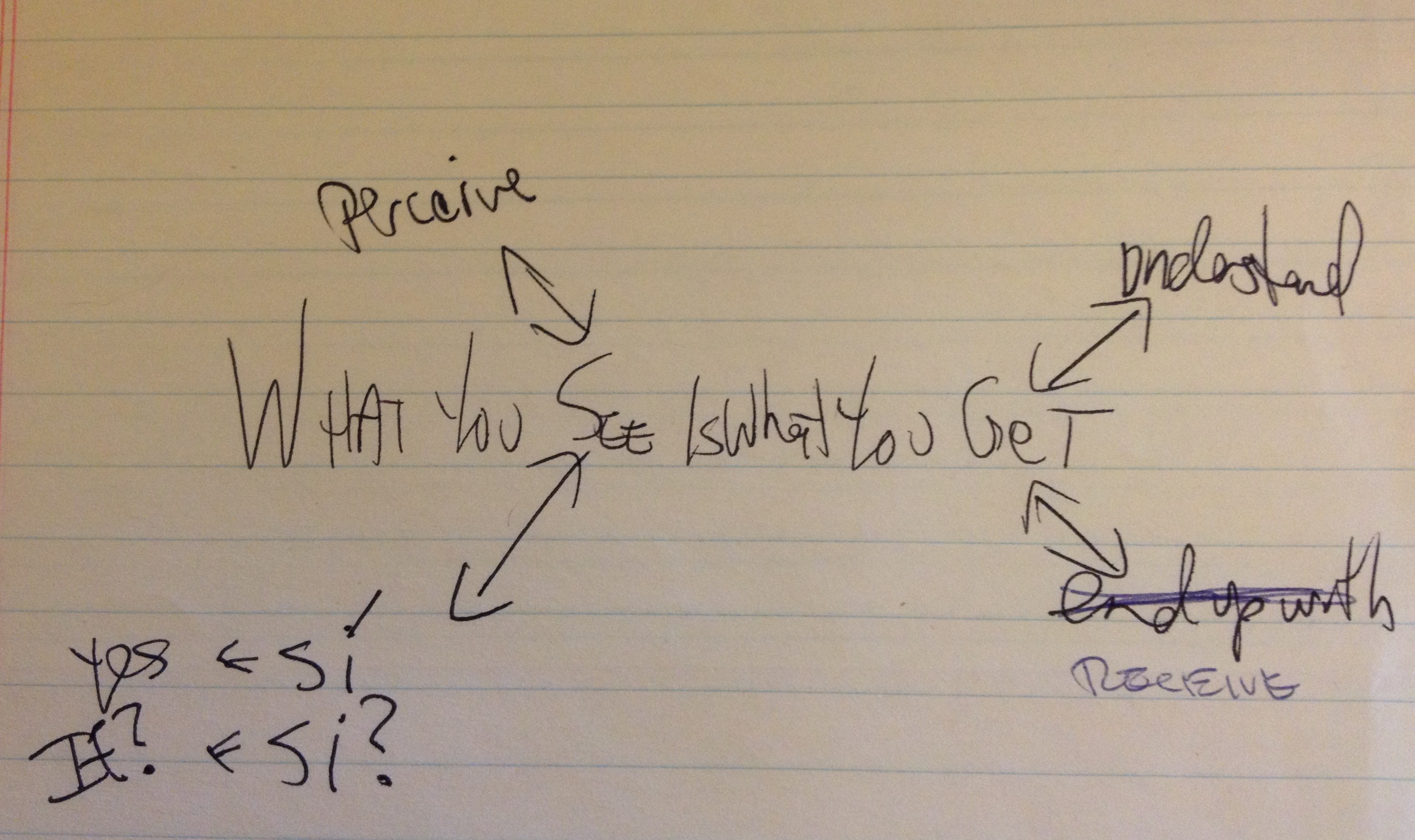
As an undergraduate I took poetry classes. I started writing in junior high and high school and entered college as an aspiring Allen Ginsburg. Well I was big and hairy and angst ridden; but not as talented. One of my favorite pieces was more word art than poem. It is non-linear and in hindsight looked a bit like a crude mind map, even though it was created about before I ever hear of mind maps. Here is a photo from my hand written draft.

What you see handwritten

Last year I was looking through some files and came across this relic and decided to type it up. After fooling around in Word I realized that the best tool I had available to me was MindJet, mind-mapping software. From there the creativity kicked in and I played with the whole concept a bit and came up with this version.

What

It’s great when our tools do more than just help us be organized and productive. Sometimes they can unlock our creativity and reconnect us with our natural talents, interests or just let us indulge our whims. I like the freedom that comes from blowing off the doors and putting ourselves out there.

Tagged with: , , , , , , , , , , , , , , ,
Posted in creativity, personal productivity

The Art of Followership – What I learned from Yoga and Business

Lot’s of material out there on Leadership.  Not as much on Followership.

Here are a couple of thoughts.

Yoga instructors, good ones, present a model and encourage you to build your own practice.  You can’t really get yoga until you get it internally.  It’s not just about perfecting a pose.  It’s about a change from within that is reflected without.

Then you get feedback, you get encourage to find your ‘edge’ to go further, try more, all the while having the personal responsibility to make the practice a thing of value you to yourself.

I used to work for American International Group.  Put aside what you believe you know about AIG from the bailout days.  The company was founded by an American living in Shanghai in the 1920’s name C.V. Starr.  In its first 80 years it had only two CEOs.  It has had five in the last six years.  When I was running the Educational Technology department for AIG’s corporate HR department, I put together an interactive history of the company and got to interview many of the company elders, people who had worked for Starr.  They all quoted a message from Starr that was identical; “Treat the company as if it were your own and you will make good decisions”.  Starr had to trust his lieutenants because of the time he lived in.  He sent them into new countries with a small amount of cash and maybe a car.  Forget email, blackberry, even phones.  His people couldn’t check in with him on every decision they made.  They might have monthly mail contact and a telex in an emergency.  Those followers, with the trust placed in them, had to internalize the ethics and vision of their leader and then become the company.  Good followers make the vision their own, just as I make my practice my own.

When I got my first job, my father told me ‘you do your job and if you find you have a free minute and no one is telling you what to do, you look around and see what needs to be done.  If you don’t see something that needs doing, grab a broom and sweep up’.  A good follower anticipates, suggests, cares about the customers as if they were his/her own (hint:they are). Responsibility is the ‘ability to respond’.  In the NYC subways there is a campaign on preventing terrorism called “if you see something, say something”.  For we followers I would say “If you see something, DO something”.  If you are in front of the customer or co-worker and a need arises, you are the one with the ‘ability to respond’.

Good Followers lead from below.  Never present a problem or issue without presenting two or more potential solutions.  Your ideas and creativity can influence outcomes just as easily as those of the leader.  Understanding the key outcomes of the organization; be it business, volunteer, family etc., allows you to apply your experience and insight to move a solution forward.  Match your outcomes with that of the organization so that your Followership can be most effective.

In today’s matrixed world, it is rare that anyone fill only a follower role.  We amble back and forth.  To my team, I am leader, to my boss I am follower.  In non-hierarchical relationships our position is fluid as well.  The key skills are problem solving and communication.  Domain knowledge can be obtained as you move from role to role, organization to organization and project to project.  Honing the skills of listening, persuading, strategizing, idea generation, developing alternative, teamwork, flexibility will enable each of us to be effective in all of the roles we occupy.

Followership is the true power skill because it is those of us with boots on the ground that actually get things done.


Tagged with: , , , , , , , ,
Posted in Leadership